-
Courses
Courses
Choosing a course is one of the most important decisions you'll ever make! View our courses and see what our students and lecturers have to say about the courses you are interested in at the links below.
-
University Life

University Life
Each year more than 4,000 choose University of Galway as their University of choice. Find out what life at University of Galway is all about here.
-
About University of Galway

About University of Galway
Since 1845, University of Galway has been sharing the highest quality teaching and research with Ireland and the world. Find out what makes our University so special – from our distinguished history to the latest news and campus developments.
-
Colleges & Schools
Colleges & Schools
University of Galway has earned international recognition as a research-led university with a commitment to top quality teaching across a range of key areas of expertise.
-
Research & Innovation
Research & Innovation
University of Galway’s vibrant research community take on some of the most pressing challenges of our times.
-
Business & Industry
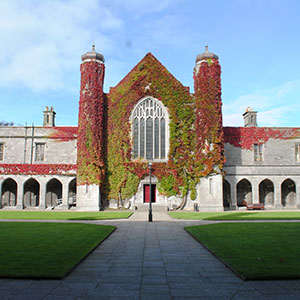
Guiding Breakthrough Research at University of Galway
We explore and facilitate commercial opportunities for the research community at University of Galway, as well as facilitating industry partnership.
-
Alumni & Friends
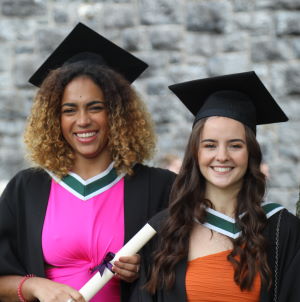
Alumni & Friends
There are 128,000 University of Galway alumni worldwide. Stay connected to your alumni community! Join our social networks and update your details online.
-
Community Engagement
Community Engagement
At University of Galway, we believe that the best learning takes place when you apply what you learn in a real world context. That's why many of our courses include work placements or community projects.
 Accessibility & Language
September Commonly used cancer drugs boost MRSA antibiotics – new research
Commonly used cancer drugs boost MRSA antibiotics – new research
Tuesday, 8 September 2026
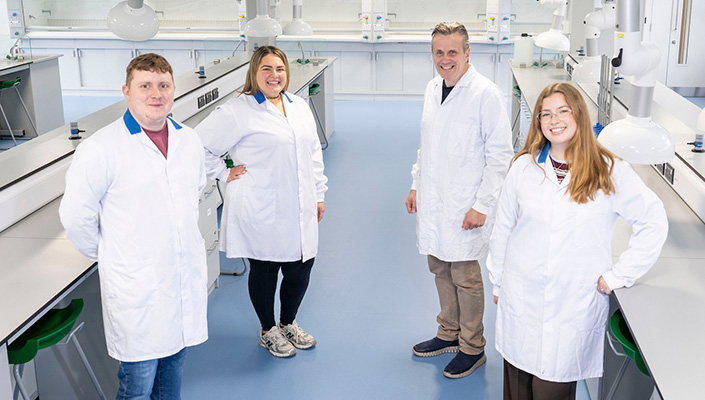
Dr Aaron Nolan, Postdoctoral Researcher and lecturer in Microbiology, Dr Merve Zeden, Assistant Professor in Microbiology, Professor James O’Gara, Professor of Microbiology, and Sarah Byrne, PhD Researcher in Microbiology. Credit – Andrew Downes, Xposure.
Scientific study reveals unexpected links between anti-cancer drugs and antibiotic effectiveness
Scientists from University of Galway have uncovered a surprising link between commonly used anti-cancer drugs and antibiotics that could offer a potential new approach to tackling notorious superbug infections.
The research team set out to find new ways to treat methicillin-resistant Staphylococcus aureus – better known as MRSA infections - using drugs that are currently ineffective due to antibiotic resistance – a growing challenge in healthcare.
The study investigated whether a range of anti-cancer drugs could help penicillin-type antibiotics, which are among the most widely used antibiotics, to become effective again.
The study was carried out by researchers Dr Aaron Nolan, Sarah Byrne, Dr Merve Zeden and Professor James O’Gara from the School of Biological and Chemical Sciences at University of Galway.
The team tested five anti-cancer drugs and revealed that four of them (5-fluorouracil; 5-fluororidine; gemcitabine; and mitomycin C) helped penicillin-type antibiotics to kill MRSA. These drugs interfere with the bacteria’s ability to make DNA, making the bacteria more vulnerable to the antibiotics.
A fifth anti-cancer drug which was tested (6-thioguanine) had the opposite effect and reduced the effectiveness of the antibiotics. Although this drug also affects DNA production in MRSA, it works in a different way, which may explain the different effects.
Dr Aaron Nolan, Postdoctoral Researcher and lecturer in Microbiology, explained: "We discovered several anti-cancer drugs that helped antibiotics to kill MRSA. But we also identified one anti-cancer drug that interfered with antibiotic effectiveness highlighting the importance of carefully prescribing the most appropriate antibiotic in patients undergoing chemotherapy."
Sarah Byrne, PhD Researcher in Microbiology, said: “The antibiotic resistance crisis is one of the world's most urgent health challenges. These findings are particularly important for patients with cancer who may need treatment for bacterial infections while also taking chemotherapy drugs.”
MRSA is a type of S. aureus bacteria that has developed resistance to commonly used antibiotics, making infections more difficult to treat.
The findings also suggest that drugs already used to treat cancer could potentially be used alongside antibiotics to help them work against resistant bacteria.
Assistant Professor in Microbiology Dr Merve Zeden said: "Our findings suggest that certain drugs originally developed for cancer treatment may have the potential to be repurposed alongside antibiotics. This could offer a new strategy to re-sensitise bacteria that have become resistant to existing treatments."
The findings build on the team's ongoing research, which has identified the process of DNA production as a vulnerability in MRSA. By interfering with this process, some of the anti-cancer drugs tested in the study appear to make the bacteria more vulnerable to antibiotics.
The discovery opens new avenues for research into combination therapies that pair antibiotics with non-antibiotic drugs. Such approaches could help extend the lifespan of existing antibiotics and provide new options for infections caused by bacteria resistant to traditional antibiotic treatments.
Professor of Microbiology at University of Galway, James O'Gara, said: “We are excited by this discovery, which advances our long-term goal of finding new ways to boost the effectiveness of existing antibiotics against superbugs like MRSA. Because this approach relies on existing medications rather than developing completely new drugs, it could provide a faster route towards developing new strategies to improve patient care."
The paper is published in mBio, the flagship journal of the American Society for Microbiology, is available at https://journals.asm.org/doi/10.1128/mbio.01274-26.
Ends
Keywords: Press.
Author: Marketing and Communications, NUI Galway
« Back
Related news
15 October 2026
Ollscoil na Gaillimhe ag ceiliúradh agus beagnach 2,800 duine ag fáil a gcéime ag na searmanais bhronnta
15 October 2026
University of Galway celebrates almost 2,800 graduates at conferring ceremonies
14 October 2026
University of Galway awarded Jean Monnet Centre of Excellence
13 October 2026
European research partnership to strengthen child protection and wellbeing
9 October 2026
Atlantic Summit Galway 2026 concludes with release of Statement to support a sustainable and prosperous ocean future
Featured Stories
Thursday,
15
October
2026
Ollscoil na Gaillimhe ag ceiliúradh agus beagnach 2,800 duine ag fáil a gcéime ag na searmanais bhronnta
Thursday,
15
October
2026
University of Galway celebrates almost 2,800 graduates at conferring ceremonies
Wednesday,
14
October
2026