-
Courses

Courses
Choosing a course is one of the most important decisions you'll ever make! View our courses and see what our students and lecturers have to say about the courses you are interested in at the links below.
-
University Life

University Life
Each year more than 4,000 choose University of Galway as their University of choice. Find out what life at University of Galway is all about here.
-
About University of Galway
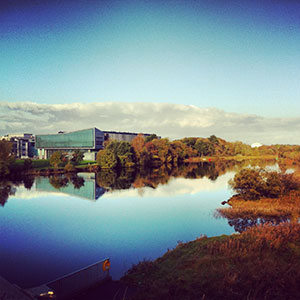
About University of Galway
Since 1845, University of Galway has been sharing the highest quality teaching and research with Ireland and the world. Find out what makes our University so special – from our distinguished history to the latest news and campus developments.
-
Colleges & Schools
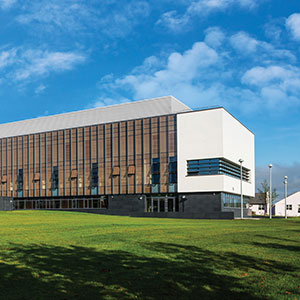
Colleges & Schools
University of Galway has earned international recognition as a research-led university with a commitment to top quality teaching across a range of key areas of expertise.
-
Research & Innovation

Research & Innovation
University of Galway’s vibrant research community take on some of the most pressing challenges of our times.
-
Business & Industry
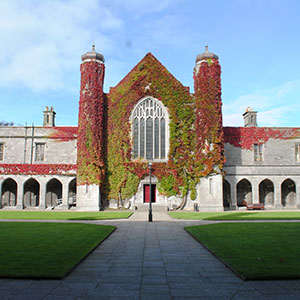
Guiding Breakthrough Research at University of Galway
We explore and facilitate commercial opportunities for the research community at University of Galway, as well as facilitating industry partnership.
-
Alumni & Friends

Alumni & Friends
There are 128,000 University of Galway alumni worldwide. Stay connected to your alumni community! Join our social networks and update your details online.
-
Community Engagement
Community Engagement
At University of Galway, we believe that the best learning takes place when you apply what you learn in a real world context. That's why many of our courses include work placements or community projects.
 Accessibility & Language
Occupational Health & Safety Top-Up (MSc)

MSc (Occupational Health & Safety Top-Up)
College of Science and Engineering- Title of Award
- Master of Science
- Course Code
- 1MOH3
- Delivery
- On Campus
- NFQ
- Level 9
- Award Type
- Major
- Duration
- 1 year Full-time
- ECTS Weighting
- 30 ECTS
Why Choose This Course?
Course Information
Who is this course for?
This one-year programme has been designed exclusively for University of Galway graduates only who have completed either of the following two historical programmes specifically titled: "Higher Diploma in Occupational Health and Safety" or "Higher Diploma in Occupational Health, Safety and Hygiene". Applicants must also have relevant work experience in Occupational Health and Safety or Occupational Health. Note: The current "HDip in Environmental and Occupational Health & Safety" does not apply .
What will I study?
Graduates are provided with an opportunity to complete the additional 30 credits (one module) required to upgrade their qualification to the MSc Occupational Health and Safety programme
The minor research thesis may be completed at the student’s place of work or in collaboration with University of Galway-based researchers. The summer period will be used to complete the minor dissertation.
Core modules:
- Research Thesis PH5112 (30credits)
Curriculum Information
Curriculum information relates to the current academic year (in most cases).Course and module offerings and details may be subject to change.
Glossary of Terms
- Credits
- You must earn a defined number of credits (aka ECTS) to complete each year of your course. You do this by taking all of its required modules as well as the correct number of optional modules to obtain that year's total number of credits.
- Module
- An examinable portion of a subject or course, for which you attend lectures and/or tutorials and carry out assignments. E.g. Algebra and Calculus could be modules within the subject Mathematics. Each module has a unique module code eg. MA140.
- Optional
- A module you may choose to study.
- Required
- A module that you must study if you choose this course (or subject).
- Semester
- Most courses have 2 semesters (aka terms) per year.
Year 1 (30 Credits)
RequiredOH503: Research Thesis
OH503: Research Thesis
15 months long | Credits: 30
This module aims to allow students to develop specific skills and competencies to design and execute research work in occupational & Environmental health and safety
Learning Outcomes
- Explain objectives and develop a research hypothesis
- Critically review and interpret research articles and conduct a research literature review
- Select, justify, and recommend a range of specialist and novel research tools and methodologies to collect, analyse and synthesise data
- Select, assess and apply research methodologies for different research questions.
- Collect and discuss research data
- Analyse and interpret research data
- Effectively Communicate research data and present the results to the scientific community
- Self evaluate the outcome of your Research Thesis and make recommendations for future research
Assessments
- Research (100%)
Teachers & Administrators
Click a name to search for their researcher profile. Note: Only teachers publish research profiles.
- MIRIAM BYRNE 🖂
- DEIRDRE CALLANAN 🖂
- MARIE COGGINS 🖂
- ENDA FRANCIS FALLON 🖂
- VICTORIA HOGAN 🖂
- MARTINA KELLY 🖂
- ANNE O'GRADY 🖂
- LISA PURSELL 🖂
- JANE SIXSMITH 🖂
- Helena Martin 🖂
Reading List
- "Health Sciences literature review made easy: The matrix method" by Jones & Bartlett Garrand, J.
- "Research Design: Qualitative, Quantitative, and Mixed Methods Approaches" by Creswell, J. W.
Publisher: Sage Publications Inc. - "Human Factors Methods" by Human Factors Methods
- "Practical Guide for Engineering and Design" by Ashgate.
- "Applications of case study research" by Yin, R. K.
Publisher: 2003) - "Human Factors Methods and Accident Analysis. Ashgate." by Salmon, P., Stanton, N., Lenne, M., Jenkins, D., Rafferty, L. and Walker, G
Note: Module offerings and details may be subject to change.
- Longest running course in its field in Ireland.
- High employability rates as there is a continuous demand for OEHS specialists.
- This course is taught by a staff from Science, Health Promotion and Engineering who are subject experts.
Our MSc (Occupational Health & Safety Top Up) opens the door to exciting careers, not just in Ireland but all over the world.
There is a continuous demand for our graduates as all organisations have legal duties and regulatory requirements with which they must comply.
Our graduates fill key posts as EHS professionals and Managers, Occupational Hygienists, Ergonomists, Health and Safety Engineers, Consultants and Advisors across a range of sectors including, manufacturing, pharmaceutical, healthcare, construction and consultancy as well as regulatory and public bodies.
Recent master’s graduates have gone on to work in (for example) :
- Medtronic
- Boston Scientific
- Pfizer
- Merit Medical
- Creganna
- Aerogen
- Uisce Éireann
- Iarnród Éireann
- Health & Safety Authority
The MSc Occupational Health and Safety Top up is designed to develop students’ proficiency across the multiple inter-related domains required for professional practice in the field of occupational and environmental health & safety, with a specific focus on real-world application and the development of personal and professional skills.
Graduates are provided with an opportunity to complete the additional 30 credits (one module) required to upgrade their qualification to the MSc Occupational Health and Safety programme. This final dissertation will help you develop independence and critical thinking. It may be completed at the student’s place of work or in collaboration with University of Galway-based researchers over the summer period.
You will learn through a mix of Research Thesis preparation lectures and workshops led by experts in the field.
Course queries:
joan.walsh@universityofgalway.ie
Programme Director(s):
Joan Walsh
Occupational and Environmental Health & Safety Lecturer
School Natural Sciences
College of Science and Engineering
E: joan.walsh@universityofgalway.ie
T: 091 492495
Accreditations & Awards
.jpg)
With over twenty years of experience as a Clinical Nurse Specialist in Occupational Health, I returned to further my academic development by completing the Top-Up MSc in Environmental and Occupational Health and Safety. The exceptional support I received from the college and my supervisor strengthened my expertise and inspired me to continue advancing my professional education. Motivated by this experience, I pursued additional studies in Advanced Nurse Practice and have since progressed into my current role as an Advanced Nurse Practitioner in Occupational Health and Wellbeing.
Siobhán Bulfin
Advanced Nurse Practitioner in Occupational Health and Wellbeing.
Meet our Employers
.jpg)



Entry Requirements and Fees
This one-year programme has been designed exclusively for University of Galway graduates only who have completed either of the following two historical programmes specifically titled: "Higher Diploma in Occupational Health and Safety" or "Higher Diploma in Occupational Health, Safety and Hygiene". Applicants must also have relevant work experience in Occupational Health and Safety or Occupational Health. Graduates are provided with an opportunity to complete the additional 30 credits (one module) required to upgrade their qualification to the MSc Occupational Health and Safety programme. Note: The current "HDip in Occupational and Environmental Health & Safety" does not apply.
How to Apply
You can apply online to the University of Galway application portal here.
Please review the entry requirements set out in the section above.
You will be required to upload supporting documentation to your application electronically. See the section above on entry requirements for further information on the supporting documentation required for this course.
Closing Dates
For this programme, there is no specific closing date for receipt of applications. Applications will be accepted on a rolling basis and course quotes will be reviewed continuously throughout the application cycle.
Notes
- You will need an active email account to use the website and you'll be guided through the system, step by step, until you complete the online form.
Browse the FAQ's section for further guidance.
| Course Type | Year | EU Tuition | Student Contribution | Non-EU Tuition | Levy | Total Fee | Total EU Fee | Total Non-EU Fee |
|---|
Why University of Galway?
World renowned research led university nestled in the vibrant heart of Galway city on Ireland's scenic West Coast.
Contact the College of Science and Engineering
University of Galway, University Road, Galway, Ireland, H91 TK33


Downloads

Meet Our Alumni
Course Introduction
This one-year programme has been designed exclusively for University of Galway graduates only who have completed either of the following two historical programmes specifically titled: "Higher Diploma in Occupational Health and Safety" or "Higher Diploma in Occupational Health, Safety and Hygiene". Applicants must also have relevant work experience in Occupational Health and Safety or Occupational Health. Graduates are provided with an opportunity to complete the additional 30 credits (one module) required to upgrade their qualification to the MSc Occupational Health and Safety programme.
MSc Occupational Health Safety (Top-up) Brochureintroduction-565X340.png)