-
Courses
Courses
Choosing a course is one of the most important decisions you'll ever make! View our courses and see what our students and lecturers have to say about the courses you are interested in at the links below.
-
University Life

University Life
Each year more than 4,000 choose University of Galway as their University of choice. Find out what life at University of Galway is all about here.
-
About University of Galway
About University of Galway
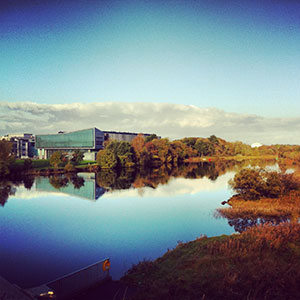
Since 1845, University of Galway has been sharing the highest quality teaching and research with Ireland and the world. Find out what makes our University so special – from our distinguished history to the latest news and campus developments.
-
Colleges & Schools
Colleges & Schools
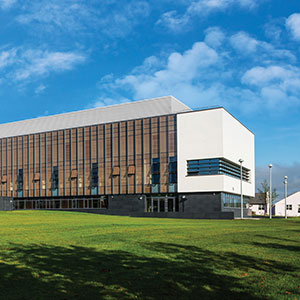
University of Galway has earned international recognition as a research-led university with a commitment to top quality teaching across a range of key areas of expertise.
-
Research & Innovation
Research & Innovation
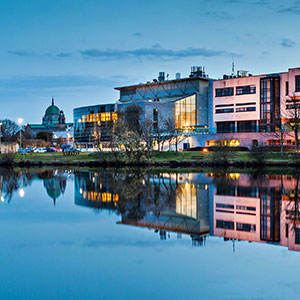
University of Galway’s vibrant research community take on some of the most pressing challenges of our times.
-
Business & Industry
Guiding Breakthrough Research at University of Galway
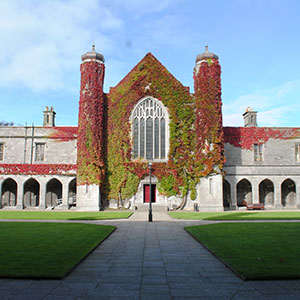
We explore and facilitate commercial opportunities for the research community at University of Galway, as well as facilitating industry partnership.
-
Alumni & Friends
Alumni & Friends
There are 128,000 University of Galway alumni worldwide. Stay connected to your alumni community! Join our social networks and update your details online.
-
Community Engagement
Community Engagement
At University of Galway, we believe that the best learning takes place when you apply what you learn in a real world context. That's why many of our courses include work placements or community projects.
 Accessibility & Language
Literature and Publishing (MA)
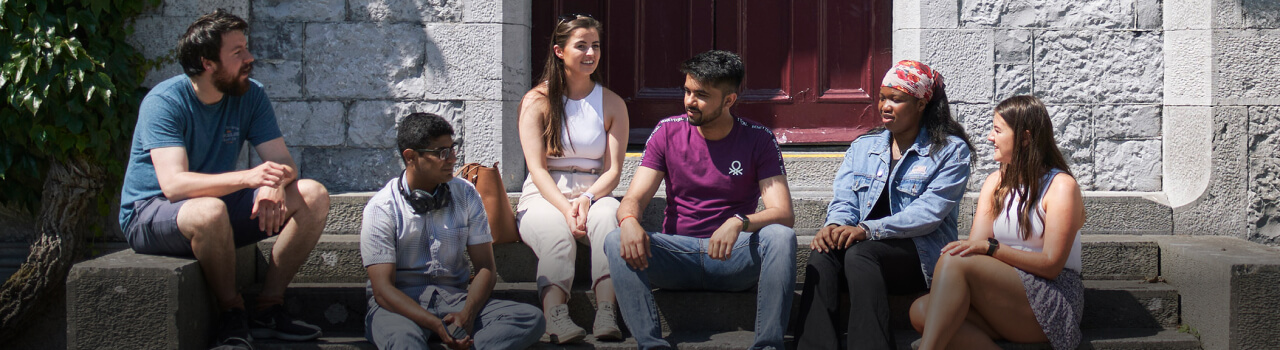
MA (Literature and Publishing)
College of Arts, Social Sciences & Celtic Studies- Title of Award
- Master of Arts
- Course Code
- 1MLP1
- Average Intake
- 20
- Delivery
- On Campus
- NFQ
- Level 9
- Award Type
- Major
- Next Intake
- September 2027
- Duration
- 1 year, full-time
- ECTS Weighting
- 90
Why Choose This Course?
Course Information
Who is this course for?
The MA in Literature and Publishing is perfect for individuals who are eager to deepen their academic skills in literary analysis and research while also developing new competencies and practical publishing experience. If you are interested in exploring the interfaces between writing and the marketplace, between literature and transmission, and between the aesthetic and material aspects of texts, then this programme will appeal to you.
This course welcomes applicants with a background in English and related disciplines, as well as those with an interest in the creative industries. With a flexible curriculum that includes a broad variety of literary topics, workshops with guest speakers from publishing and related industries, and hands-on experience producing the literary journal ROPES, the MA in Literature and Publshing is designed for students looking to take a dynamic and active approach to learning.
What will I study?
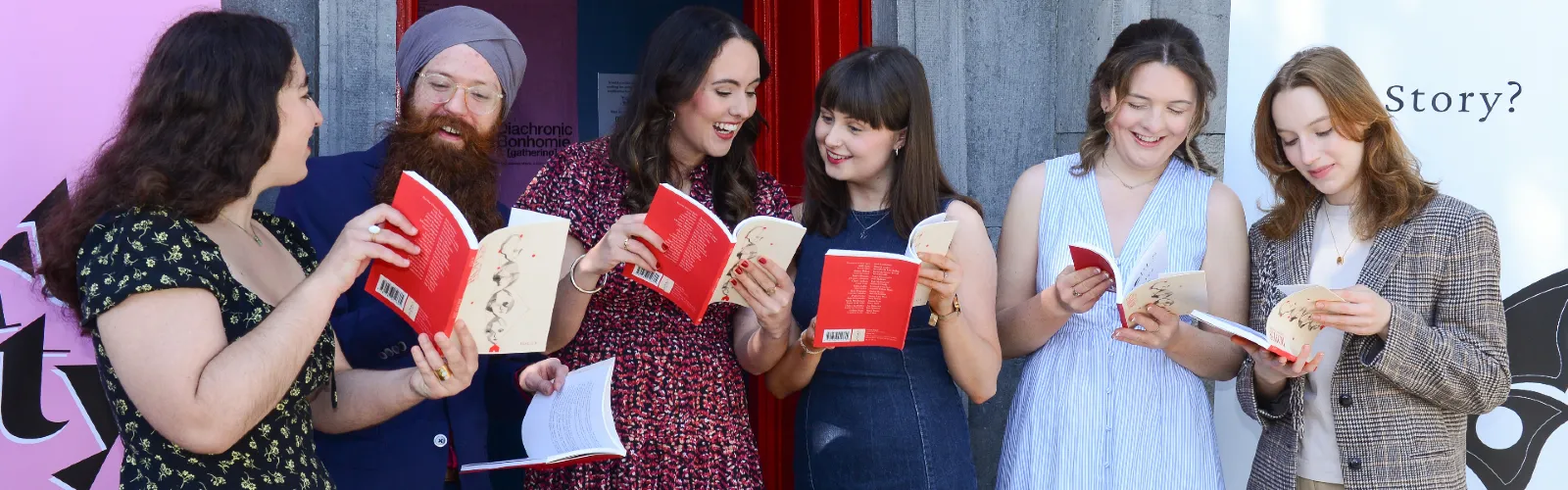
There are three main components to the MA in Literature and Publishing curriculum: assessed modules, ROPES, and the MA Portfolio Project or Dissertation. You will enrol in six taught modules (3 in each semester). Throughout the academic year, you will have the option to work on ROPES, an extracurricular project that provides participating students with practical, cv-enhancing experience in project management, production, marketing, sales, design, and teamwork. During Semester 2, you will begin work on the research and writing of either a research-based MA dissertation or an MA Portfolio Project, which you complete during the summer and submit in mid-August.
Core modules:
- Book History: Objects, Materials, Digital Affordances
- Contemporary Publishing
- Publishing: Perspectives and Professionalisation
Optional modules might include:
- Books Journalism
- Children’s Fiction and Young Adult Fiction in the 21st Century
- Copy-Editing and Proofreading
- Environmental Literature: Nature and Narration
- Language, Gender, and Power
- Literature of North America
- Literature and Colonialism
- Media for Social Change
- Negotiation (the leadership and management skill)
- Service Learning: Literary Studies in the Community
- Social Media Marketing Theory
- Travel Literature
- Yeats and the Cultural Revolution
Curriculum Information
Curriculum information relates to the current academic year (in most cases).Course and module offerings and details may be subject to change.
Glossary of Terms
- Credits
- You must earn a defined number of credits (aka ECTS) to complete each year of your course. You do this by taking all of its required modules as well as the correct number of optional modules to obtain that year's total number of credits.
- Module
- An examinable portion of a subject or course, for which you attend lectures and/or tutorials and carry out assignments. E.g. Algebra and Calculus could be modules within the subject Mathematics. Each module has a unique module code eg. MA140.
- Subject
- Some courses allow you to choose subjects, where related modules are grouped together. Subjects have their own required number of credits, so you must take all that subject's required modules and may also need to obtain the remainder of the subject's total credits by choosing from its available optional modules.
- Optional
- A module you may choose to study.
- Required
- A module that you must study if you choose this course (or subject).
- Required Core Subject
- A subject you must study because it's integral to that course.
- Semester
- Most courses have 2 semesters (aka terms) per year, so a three-year course will have six semesters in total. For clarity, this page will refer to the first semester of year 2 as 'Semester 3'.
Year 1 (90 Credits)
OptionalEN527: Literature Of North America - 10 Credits - Semester 1OptionalMK5139: Social Media Marketing Theory - 5 Credits - Semester 1
OptionalFR6101: Language, Gender and Power - 10 Credits - Semester 1
OptionalEN6125: WB Yeats and the Cultural Revolution - 10 Credits - Semester 1
OptionalEN672: Environmental Literature: Nature and Narration - 10 Credits - Semester 1
OptionalEN6140: Publishing History - 5 Credits - Semester 1
OptionalSP6159: Critical Theory and Media: Power, Resistance and Social Change - 10 Credits - Semester 1
RequiredEN6128: Publishing: Perspectives and Professionalisation - 10 Credits - Semester 1
RequiredEN579: Contemporary Publishing - 10 Credits - Semester 1
RequiredEN6133: Literature and Publishing Portfolio Project - 30 Credits - Semester 1
OptionalEN6143: Media for Social Change - 10 Credits - Semester 2
OptionalEN581: Copy-editing and Proofreading - 10 Credits - Semester 2
OptionalEN6101: Books Journalism - 10 Credits - Semester 2
OptionalMK5116: Negotiations - 5 Credits - Semester 2
OptionalEN671: Literature for Children and Young Adults in the 21st Century - 10 Credits - Semester 2
OptionalHI6111: Representing Transatlantic Slavery: Race, History and Memory - 10 Credits - Semester 2
OptionalEN6141: SERVICE LEARNING: LITERARY STUDIES IN THE COMMUNITY - 10 Credits - Semester 2
OptionalEN6146: Literary Fiction and the Bad Romance - 10 Credits - Semester 2
OptionalEN547: Literature And Colonialism - 10 Credits - Semester 2
RequiredEN570: Book History - 10 Credits - Semester 2
- Industry exposure: Benefit from contact with guest speakers from publishing and related industries who share their experiences and perspectives. Visiting speakers in recent years have come from Tramp Press, O’Brien Press, Gill Books and Cúirt International Festival of Literature.
- Hands-on experience: As well as gaining practical experience working on ROPES, students may volunteer with book fairs and literary festivals, or place as interns with Irish publishers.
- Specialist skills: Participate in workshops dedicated to topics like internships, writing cvs and cover letters, developing interview skills, and maintaining a personal digital brand. Students also gain Adobe InDesign training.
- Range of modules: Choose modules on a wide variety of topics, including literary and book history, environmental literature, colonial culture, marketing, creative writing and editing.
- Research dissertation / portfolio: Develop advanced skills in research, writing, and extended analysis by completing an original dissertation or portfolio based on your own interests.
- Community: Be part of a lively postgraduate community in the School of English, Media and Creative Arts, with opportunities to meet and attend courses and events with students from other MA programmes.
The MA in Literature and Publishing prepares you for a wide-range of exciting careers in publishing, the creative industries and beyond. The combination of advanced research, critical thinking and communication skills and practical knowledge fostered by the programme is highly relevant to employment in fields including: publishing and related industries, teaching, arts administration, public service, public relations, marketing, publishing, broadcasting and journalism. Some students also continue to further postgraduate studies, including PhD research and career opportunities in academia.
In recent years, graduates from the programme have filled posts as agents, editors and booksellers. They have gone on to work at companies including: Curtis Brown Books, Gill Education, Irish Writers Centre, Kenny's Books, Lilliput Press, Literature Ireland, O’Brien Press, Pan Macmillan, Poetry Ireland, Penguin, RTE, and UCD Press.
How Will I Learn?
Most of your learning will take place in weekly small-group seminars and workshops, some of them shared with students from other MA programmes such as the MA in English and the MA in Writing. Some modules may involve group projects and collaborative activities that will enhance your teamwork and communication skills, and these competencies will also be honed through your extracurricular work on ROPES. Individual assignments and the dissertation/portfolio will help you develop intellectual independence and critical thinking. The emphasis is on informed group discussion, and the development of individual analytic and creative skills. When you work on your dissertation and portfolio, you will be assigned a supervisor who will advise on the early stages of your topic formulation, structure and drafting.
Throughout the programme, you will have access to Adobe InDesign, the most widely used software in the publishing industry. You will also be able to use the extensive digital and physical resources of the James Hardiman Library.
How Will I Be Assessed?
Your progress throughout the programme is assessed through various kinds of coursework, including essays, oral presentations, reflective journals and project work. You will also be assessed on your 15,000-word dissertation/portfolio. Your coursework amounts to 60 ECTS in total; the final dissertation or portfolio amounts to 30 ECTS.
Macha Press
Join us for an engaging discussion with poet Sam Furlong and Macha Press Editor Lorna Shaughnessy. Together, they’ll explore Macha Press’s collaborative editorial model and co-active design approach, with a live reading from Sam’s debut poetry collection Crowd Work.
.jpg)
ROPES launch
https://www.cuirt.ie/whats-on/ropes-launch/
latest issue of ROPES: https://www.ropesliteraryjournal.com/catalog/
Tony Farmar Memorial Prize
Congratulations to Laoise Ní Cháinte (MA in Literature & Publishing 2023-24) who has been awarded the Tony Farmar Memorial Prize for her dissertation, “‘Safe as Houses’: The Domestic Spaces of Tana French's Dublin Murder Squad.”
The Tony Farmar Dissertation Prize is an annual award of €1,000 sponsored by ICLA, The Irish Copyright Licensing Agency (https://www.icla.ie/). It is offered annually to recognise excellence on the MA in Literature and Publishing in the Discipline of English at University of Galway.
The prize is a tribute to Tony Farmar who had a long and distinguished career in publishing and a passionate interest in Irish business and social history including his final work, The History of Irish Book Publishing. Tony was President of Publishing Ireland and the Irish Copyright Licensing Agency, both of which benefited significantly from his wisdom and guidance.
Well done Laoise!
Course queries:
alexandra.peat@universityofgalway.ie
Programme Director:
Dr Alexandra Peat
School of English, Media and Creative Arts
College of Arts, Social Sciences and Celtic Studies
E: alexandra.peat@universityofgalway.ie
Candidates who do not meet the minimum entry criteria are encouraged to contact the programme director to discuss eligibility under the Recognition of Prior Learning (RPL) process. Such candidates may be interviewed to ascertain their suitability for the programme. Further information is available on the University’s Recognition of Prior Learning website here.
Graduates of the MA in Literature and Publishing will be able to:
- Demonstrate a breadth of understanding of a range of approaches to the study of literary texts and other cultural artefacts.
- Select and apply a variety of critical approaches to the study of literature.
- Retrieve, select, sift, and deploy a range of sources to support original arguments.
- Demonstrate competencies in areas such as marketing, the practical elements of editorial and production work, and the business aspects of contemporary publishing.
- Plan, manage, and complete a substantial independent study project.
- Reflect deeply on a range of research perspectives, topics, and approaches related to literary study and book history.
- Exhibit the ability to self-assess and self-direct.
Accreditations & Awards
This MA gave me a good understanding of the publishing process and industry through a mixture of practical and more theory-based modules. I could then put that knowledge into action through the publication of ROPES. After completing the course, I found that employers responded positively to the qualification and that it is well respected within the industry. This is evident by the number of MALP graduates I have come across at various stages of my career.
Damien Lynam
Commissioning Editor, Educate.ie
I had been interested in a career in publishing for years, so the MA in Literature and Publishing was the natural next step after my undergraduate degree. I loved the variety of classes, many of which were practical and very different from my previous studies. Guest lectures from professionals, trips to publishing houses and printers, gave us fantastic real-world insight. A highlight was publishing our own literary journal, ROPES - a challenging yet invaluable experience. The value of the degree became clear when I secured a publishing internship soon after, which led to a full-time role.
Trionna Marshall
Media and Communications Officer, Royal College of Nursing

After completing the MA in Literature and Publishing, I began an internship at Ashville Media before joining Edco as a Market Research and Editorial Executive, while also earning a Postgrad Diploma in Digital Marketing. At Edco, I co-founded GirlCrew, a social network scaled to fifty cities worldwide. As a founder, I gave a TEDx talk on race and representation and was named by Forbes as a Top EU Founder to follow. In 2019, I joined The Dock, Accenture’s Global R&D and Innovation Centre, as an Innovation Designer. The MA gave me strong research, critical thinking, and problem-solving skills.
Áine Mulloy
Amazon Web Services, Former cofounder @ GirlCrew

This course combines practical and theoretical skills with excellent exposure to industry through guest lectures and field trips. It also offers support in CV preparation, interview and design skills, alongside strong academic modules. The variety of options allowed me to tailor the programme to my goals. A highlight was publishing the journal ROPES, which developed project management, teamwork, and critical thinking skills while giving hands-on industry experience. The MA in Literature and Publishing provides an excellent grounding for a career in publishing.
Susan Bennett
Research Assistant, University of Galway

The book publishing world is hard to get into, with lots of applicants for every position. Graduates of the Galway MSc Literature and Publishing, the only Irish course which teaches directly about the industry, have demonstrated a real interest in and commitment to the world of books: we have employed several, and it has always been a good call! As an occasional guest lecturer, it is clear that the class are engaged and diverse. Students learn in an environment that encourages exploration, gaining real-world experience and strong industry insight before starting their professional careers.
Employer: Ivan O'Brien
Manager Director, The O'Brien Press LTD
Meet our Employers
Entry Requirements and Fees
Minimum Entry Requirements
Minimum entry requirements for this programme include an NQAI Level 8 qualification with an overall degree result of H2.2 and with a H2.1 in one subject (or a BA with a 3.0 GPA or equivalent). Please note that admission to this programme is highly selective and meeting minimum achievement thresholds does not guarantee entry.
Candidates who do not meet the minimum entry criteria are encouraged to contact the programme director to discuss eligibility under the Recognition of Prior Learning (RPL) process. Such candidates may be interviewed to ascertain their suitability for the programme. Further information is available on the University’s Recognition of Prior Learning website here.
Academic entry requirements standardised per country are available here.
English Language Entry Requirements
For applicants whose first language is not English, a minimum IELTS of 7.0 overall or equivalent, and no less than 6.5 in any one component is required for entry to this programme.
More information on English language test equivalency are available here.
Supporting Documents
Applicants to this programme will be asked to supply the following supporting materials:
- A personal statement of approximately 600 words.
- A 1-2 page cv listing academic and professional qualifications and achievements.
- Scanned copies of full university transcripts (informal print-outs of exam results will not suffice).Note: this is not required for applicants who earned their BA from University of Galway.
- A scanned copy of a passport or birth certificate. Note: this is not required for applicants who were previously enrolled as students at NUIG.
- Two academic references. This may take the form of: a) scanned letters of support from two academic referees; b) documents listing the names and full contact details for two academic referees who would be willing to provide a letter of recommendation if contacted by the programme director.
Note: applicants who are a long time out of the education system and would struggle to find academic referees are advised to contact the programme director to discuss their situation.
You can apply online to the University of Galway application portal here.
Please review the entry requirements set out in the section above.
You will be required to upload supporting documentation to your application electronically. See the section above on entry requirements for further information on the supporting documentation required for this course.
Closing Dates
Offers are made on a rolling basis.
Notes
- You will need an active email account to use the website and you'll be guided through the system, step by step, until you complete the online form.
- Browse the FAQ's section for further guidance.
Fees for Academic Year 2027/28
| Course Type | Year | EU Tuition | Student Contribution | Non-EU Tuition | Levy | Total Fee | Total EU Fee | Total Non-EU Fee |
|---|---|---|---|---|---|---|---|---|
| Masters Full Time | 1 | €8350 | €0 | €20400 | €150 | €150 | €8500 | €20550 |
Postgraduate students in receipt of a SUSI grant – please note an F4 grant is where SUSI will pay €4,500 towards your tuition (2026/27). You will be liable for the remainder of the total fee. A P1 grant is where SUSI will pay tuition up to a maximum of €6,270. SUSI will not cover the student levy.
Note to non-EU students: learn about the 24-month Stayback Visa here.
Postgraduate Excellence Scholarships
This scholarship is valued at €1,500 for EU students applying for full-time taught master's postgraduate courses. You will be eligible if:
- You have been accepted to a full-time taught master's course at University of Galway,
- You have attained a first class honours (or equivalent) in a Level 8 primary degree.
An application for the scholarship scheme is required (separate to the application for a place on the programme). The application portal for 2025-26 is now open and available here. Applications will close on the 30th September 2025. Full details available here.
Global Scholarships
University of Galway offers a range of merit-based scholarships to students from a number of countries outside of the EU. Visit here for schemes currently available.
Application Process
Students applying for full time postgraduate programmes from outside of the European Union (EU), You can apply online to the University of Galway application portal here.
Our application portal opens on the 1st October each year for entry the following September.
Further Information
Please visit the postgraduate admissions webpage for further information on closing dates, documentation requirements, application fees and the application process.
Why University of Galway?
World renowned research led university nestled in the vibrant heart of Galway city on Ireland's scenic West Coast.
College of Arts, Social Sciences and Celtic Studies
University of Galway, University Road, Galway, Ireland, H91 TK33


Downloads

Meet Our Alumni
Course Introduction
Founded in 1995, the MA in Literature and Publishing remains Ireland’s only postgraduate programme dedicated to literature and publishing. This distinctive offering allows students to deepen their existing knowledge of literature while also developing new skills in areas such as marketing, promotions, editorial and production work, and the business aspects of contemporary publishing.