-
Courses
Courses
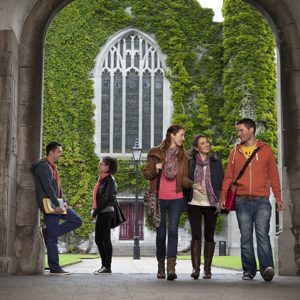
Choosing a course is one of the most important decisions you'll ever make! View our courses and see what our students and lecturers have to say about the courses you are interested in at the links below.
-
University Life

University Life
Each year more than 4,000 choose University of Galway as their University of choice. Find out what life at University of Galway is all about here.
-
About University of Galway
About University of Galway
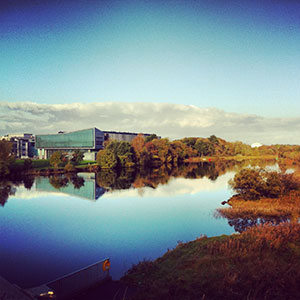
Since 1845, University of Galway has been sharing the highest quality teaching and research with Ireland and the world. Find out what makes our University so special – from our distinguished history to the latest news and campus developments.
-
Colleges & Schools
Colleges & Schools
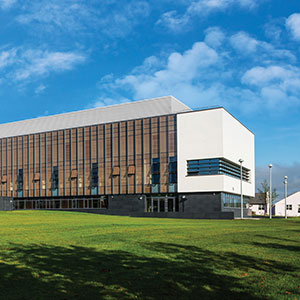
University of Galway has earned international recognition as a research-led university with a commitment to top quality teaching across a range of key areas of expertise.
-
Research & Innovation
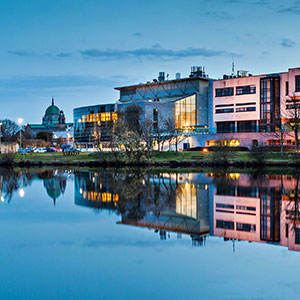
Research & Innovation
University of Galway’s vibrant research community take on some of the most pressing challenges of our times.
-
Business & Industry
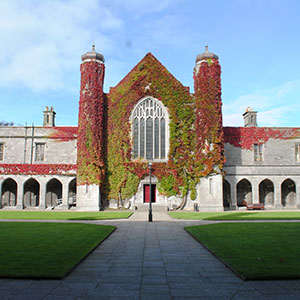
Guiding Breakthrough Research at University of Galway
We explore and facilitate commercial opportunities for the research community at University of Galway, as well as facilitating industry partnership.
-
Alumni & Friends
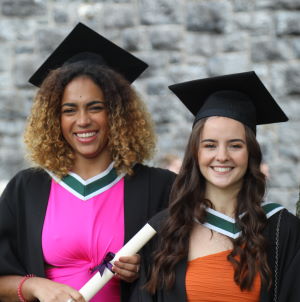
Alumni & Friends
There are 128,000 University of Galway alumni worldwide. Stay connected to your alumni community! Join our social networks and update your details online.
-
Community Engagement
Community Engagement
At University of Galway, we believe that the best learning takes place when you apply what you learn in a real world context. That's why many of our courses include work placements or community projects.
 Accessibility & Language
June University of Galway researchers secure European Research Council awards
University of Galway researchers secure European Research Council awards
Tuesday, 30 June 2026
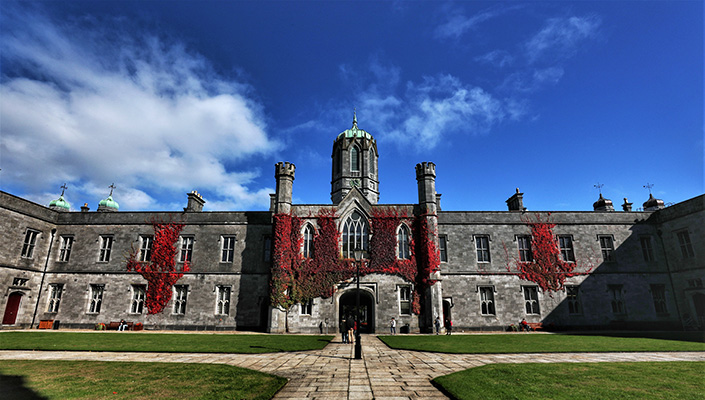
The Quadrangle, University of Galway
Researchers at University of Galway have secured prestigious funding support through the European Research Council (ERC) to progress projects on an AI-assisted clinical support tool and improve next-generation regenerative medicines.
The awards are among 182 projects across Europe which have been awarded ERC Proof of Concept grants to explore the commercial or societal potential of their research.
One project, iChatRD, will develop a user-centred clinical decision support system for the diagnosis of rare and inherited metabolic diseases.
The second project, GeIEV, will develop a new hydrogel technology that could significantly improve the delivery of next-generation regenerative medicine for tissue injury.
The European Research Council Proof of Concept scheme is funded under Horizon Europe, the EU’s framework programme for research and innovation.
iChatRD has been awarded a grant of €150,000 and will run for 18 months. The AI-assisted, fully transparent clinical decision support tool suggests expert-level rare disease diagnoses from unstructured patient descriptions within seconds.
The overall goal of the project is to translate the research prototype into a practical, clinically relevant tool, which is also aligned with regulatory requirements and market needs. The team will develop ChatRD2.0 through best practices in engaged research, working side by side with metabolic disease specialists, paediatricians, and frontline clinicians to ensure the tool is shaped by the people who will actually use it.
The project is led by Professor Ines Thiele and Research Fellow, Dr Cyrille Thinnes from the School of Medicine, School of Biological and Chemical Sciences and the Digital Metabolic Twin Centre at the University of Galway.
Dr Cyrille Thinnes, University of Galway, said: “For patients with rare diseases, reaching a diagnosis can take years and involve consultations with a dozen or more physicians. This funding gives us the opportunity to turn ChatRD, currently a research tool, into something clinicians can, and want to, use in their daily practice. Our goal is to put a reliable decision support system in the hands of the doctor who sees a patient on day one, not year five. Crucially, every suggestion ChatRD produces is fully explainable, so the clinician can see exactly why a disease was flagged, which we believe is essential for fostering trust in AI-assisted medicine.”
Professor Ines Thiele, University of Galway, said: “When exploring avenues for translating our fundamental research on digital metabolic twins into patient-focused applications, we kept encountering a major challenge: the richest clinical information exists as free text: the language of a human, not of a computer. ChatRD bridges this gap, by enabling metabolic modelling and natural language work together to suggest candidate diagnoses for inherited metabolic diseases. The ERC Proof of Concept grant now helps us take ChatRD into the real world, by working directly with clinicians to help shorten the diagnostic odyssey that may burden rare disease patients for years.”
The second project, GelEV has been awarded a grant of €150,000 and will run for 18 months. It will focus on the development of a new technology that could significantly improve the delivery of next-generation regenerative medicines for tissue injury. The project aims to validate a novel hydrogel designed to deliver extracellular vesicles (EVs), tiny particles secreted by cells, allowing them to work more effectively.
The project is led by principal investigator Dr Meadhbh Brennan and technical lead Dr Hannah Aris from the School of Engineering at University of Galway.
Dr Meadhbh Brennan, School of Engineering, University of Galway, said: “By creating a delivery platform compatible with a wide range of EV therapies, the GelEV ERC proof-of-concept project has the potential to accelerate the development of new treatments for tissue injury indications, while supporting the growing extracellular vesicles therapeutics industry.”
Ekaterina Zaharieva, European Commissioner for Startups, Research and Innovation, said: “Many of today's innovations begin with a researcher asking a fundamental question. These 182 projects show that curiosity-driven science and real-world impact go hand in hand. With Proof of Concept funding, ERC researchers can test how their discoveries could become new treatments, technologies, services or solutions that benefit people across Europe.”
Ends
Keywords: Press.
Author: Marketing and Communications , NUI Galway
« Back
Related news
20 July 2026
World premiere of Irish National Opera’s Testament to open at University of Galway
20 July 2026
Student innovators win at Start With Us incubator awards
14 July 2026
Galway International Arts Festival and University of Galway mark sweet 16-year partnership
13 July 2026
Take a trip down University Library memory lane
13 July 2026
Turas ar bhóithrín na smaointe i Leabharlann na hOllscoile