-
Courses
Courses
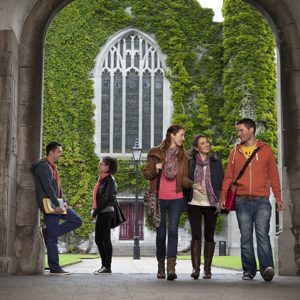
Choosing a course is one of the most important decisions you'll ever make! View our courses and see what our students and lecturers have to say about the courses you are interested in at the links below.
-
University Life

University Life
Each year more than 4,000 choose University of Galway as their University of choice. Find out what life at University of Galway is all about here.
-
About University of Galway

About University of Galway
Since 1845, University of Galway has been sharing the highest quality teaching and research with Ireland and the world. Find out what makes our University so special – from our distinguished history to the latest news and campus developments.
-
Colleges & Schools
Colleges & Schools
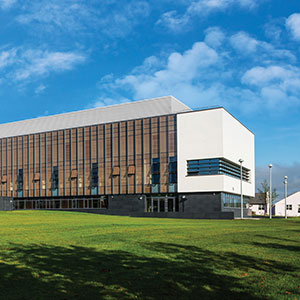
University of Galway has earned international recognition as a research-led university with a commitment to top quality teaching across a range of key areas of expertise.
-
Research & Innovation

Research & Innovation
University of Galway’s vibrant research community take on some of the most pressing challenges of our times.
-
Business & Industry
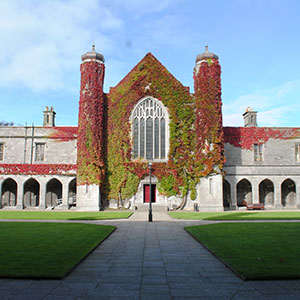
Guiding Breakthrough Research at University of Galway
We explore and facilitate commercial opportunities for the research community at University of Galway, as well as facilitating industry partnership.
-
Alumni & Friends
Alumni & Friends
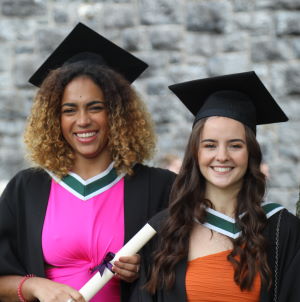
There are 128,000 University of Galway alumni worldwide. Stay connected to your alumni community! Join our social networks and update your details online.
-
Community Engagement
Community Engagement
At University of Galway, we believe that the best learning takes place when you apply what you learn in a real world context. That's why many of our courses include work placements or community projects.
 Accessibility & Language
May Study shows timing and intensity matters when exercising
Study shows timing and intensity matters when exercising
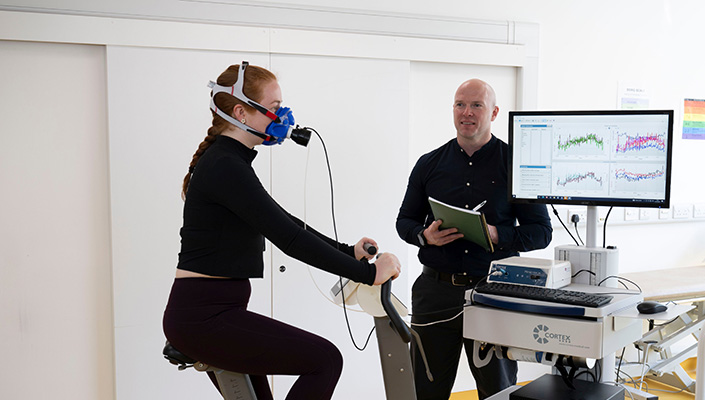
Dr Enda Murphy, Research Associate, CÚRAM – the Research Ireland Centre for Medical Devices, University of Galway, conducting an exercise physiology test with student Anna Burns. Photo: Andrew Downes, Xposure
May
13
2026
Posted: 11:52 IST
Exercise science researchers at University of Galway have revealed how careful consideration of the timing and intensity of training will benefit muscle health.
The study examined the effects of exercise on muscle, and in particular whether shorter bursts of very intensive exercise or longer periods of less intensive exercise were more effective at improving muscle health.
Dr Enda Murphy, an exercise scientist working at CÚRAM – the Research Ireland Centre for Medical Devices based at University of Galway, led the international collaboration, with scientists from Dublin City University and Toulouse University in France.
In order to fully assess the impact of exercise on muscle health, the researchers took muscle biopsy samples from participants before and after exercise. They also took very precise measures of metabolic health, including “insulin sensitivity” – a measure of how well insulin can control the flow of glucose and other fuels around the body. This made it possible to analyse very precisely the effects of exercise on metabolism within the muscle itself.
Dr Enda Murphy said: “The findings were interesting and unexpected. There were much bigger improvements in muscle function after the short, intensive exercise bouts compared to the longer bout of less intensive exercise, even though the overall workload with the short intensive bout was much lower.
“Our analysis also showed improvements in insulin sensitivity – which relates to how effectively the body’s cells respond to insulin in order to absorb glucose from the bloodstream and regulate blood sugar levels.”
The research involved young, healthy, active men involved in training or exercising at least twice a week. In order to assess how their bodies responded to the exercise, they were assessed 24 hours after sprint intervals (7x30 second high intensity sprints over 40 minutes), cycling over 1 hour (continuous moderate intensity), and while not exercising.
The full research can be read in the American Journal of Physiology - Endocrinology and Metabolism.
Dr Cedric Moro, part of the research team based in the Institute of Metabolic and Cardiovascular Diseases (I2MC) INSERM/Toulouse University France, said: “Whether the findings apply to other groups such as women, older people or those with chronic medical conditions like obesity, needs further study. However, the fact that we were able to quantify very precisely the changes in insulin sensitivity, as well as the changes in muscle at a molecular and microscopic level with the biopsy samples makes us confident that what we are seeing is real.”
Professor Francis Finucane, part of the research team and Consultant Endocrinologist, Galway University Hospitals and University of Galway, said: “This study shows the power of collaboration between specialists in metabolism, muscle function and exercise science. We know that exercise is really important for metabolic health, and making exercise interventions as effective as possible will help our patients with obesity and related disorders. This study is a small but important step on that journey.”
Ends
Related News
14 October 2026
University of Galway awarded Jean Monnet Centre of Excellence
13 October 2026
European research partnership to strengthen child protection and wellbeing
9 October 2026
Atlantic Summit Galway 2026 concludes with release of Statement to support a sustainable and prosperous ocean future
5 October 2026
Venomous snakes evolved striking colours to stand out
30 September 2026
University of Galway recognised with RTPI Accredited Planning School status
Featured Stories
Wednesday,
14
October
2026
University of Galway awarded Jean Monnet Centre of Excellence
Tuesday,
13
October
2026
European research partnership to strengthen child protection and wellbeing
Friday,
9
October
2026