-
Courses

Courses
Choosing a course is one of the most important decisions you'll ever make! View our courses and see what our students and lecturers have to say about the courses you are interested in at the links below.
-
University Life

University Life
Each year more than 4,000 choose University of Galway as their University of choice. Find out what life at University of Galway is all about here.
-
About University of Galway

About University of Galway
Since 1845, University of Galway has been sharing the highest quality teaching and research with Ireland and the world. Find out what makes our University so special – from our distinguished history to the latest news and campus developments.
-
Colleges & Schools
Colleges & Schools
University of Galway has earned international recognition as a research-led university with a commitment to top quality teaching across a range of key areas of expertise.
-
Research & Innovation

Research & Innovation
University of Galway’s vibrant research community take on some of the most pressing challenges of our times.
-
Business & Industry
Guiding Breakthrough Research at University of Galway
We explore and facilitate commercial opportunities for the research community at University of Galway, as well as facilitating industry partnership.
-
Alumni & Friends

Alumni & Friends
There are 128,000 University of Galway alumni worldwide. Stay connected to your alumni community! Join our social networks and update your details online.
-
Community Engagement
Community Engagement
At University of Galway, we believe that the best learning takes place when you apply what you learn in a real world context. That's why many of our courses include work placements or community projects.
 Accessibility & Language
News
Website / T4-Related News
This webpage details University website-related news, from the ISS web team, including anything that may be of interest to web editors / T4 users.
Note:The most recently updated items are denoted by the symbol.
2026
Site-wide Modifications
Search Engine Instructions: Individual web pages can give instructions to search engines (e.g. don't index the images on this page / don't index anything on this page but follow the links). This can be done via the section's Metadata tab, where you enter in the valid indexing and serving rules.
Note: Separate them with commas if you're adding more than one (e.g. noindex, noimageindex, nofollow). A comma is not required if you're only entering one instructions. E.g.: unavailable-after: 2026-12-31 18:00:00.000
Because of the way our news pages are published (inheriting their properties from the main page), the above method would affect all your news pages. So we have updated the 'NUIG News' content type to include a new field, which allows you to enter search engine instructions from a dropdown list. This is not as flexible as the metadata method, but it allows you to keep individual news items from search results, if ever required.
Navigation Assistant: This previous website feature has been revived - but this time, it is powered by a T4 content type. It allows pages for shared acronyms (e.g. ISS) or common names (e.g. summer schools) to be created, containing links to each of the websites that relate to it.
Site Footer: An updated 'EU Funding' Logo was required, its new design prompting a move from its old position, in the left-most column of the maroon block, to the icon ribbon, immediately below this. This icon ribbon was also applied to all Irish Language pages. [May 5, 2026]
Self-Help Improvements
- New example Content Types (CTs) have been added, including:
- Homepage Parallax Sliding
- Image Roundel with Description
- Key Fact Roundels - 2 different types (Standard and Widescreen), which hold slightly different content.
- 3 Roundel Promos
- For CTs with separate example pages, an easy toggle, between info and example, has been added.
- We've added an extra tuition page, outlining best practice for 'Writing for the Web'.
- Additional self-help videos are being created, as required. These are not part of the basic training course - they provide extra information.
- The page layout toggle buttons (used by many of the example pages) have been improved, making it easier to see how this content type will appear on different types of pages.
Content Types
Our continuing efforts to improve CMS capabilities & user experience, have resulted in more content type (CT) changes in 2026:
New Additions
An 'Alert Banner (non-course pages)' CT was introduced in January - This allows you to adjust the banner's colour, icon, message, trailing whitespace, and optional internal link.
In-Page Navigation
Another page navigation choice was added. Unlike the existing 'ToC' CT, the new 'Sticky Page Nav' allows you to limit the headlines it will link to, and it appears on the page as a horizontal bar - not a vertical one.
To complete our website's in-page navigation capabilities, an 'In-Page Search' CT was introduced in June, and put to good use on this T4 website - even on this page (see above). This CT allows website visitors to search for content that is hidden from view in the current page (e.g. in closed accordion segments, other tabs, or unopened FAQs) - something the browser's in-built search (Ctrl-F) will not do.
Content Type Simplification
We have begun efforts to simplify the process of adding content, focusing on 2 different things:
- Reducing the number of content types on offer (without reducing website capabilities)
- Making content types easier to add (reducing the steps involved & making options more intuitive)
We've started by introducing a new 'Rich Text' CT, which does the work of 4 content types:
- 'Content (Rich Text)'
- 'Content (no title)'
- 'Content Box', and
- 'Full-Screen Centred Rich Text Box'
but it is easier to use.
This change also gives you more flexibility: if you ever need to, you'll be able to change how your content looks without having to switch to a new content type.
The 4 replaced content types are being phased out and will eventually all disappear from the list of Content Types (when you click 'Add Content'). You'll still be able to edit any of these older content types, that were added previously, but to get the same functionality, from now on, you should add a 'Rich Text' CT instead.
Tweaks
The 'Widescreen Navigation Menu' CT was tweaked slightly to prevent longer link text from being overwritten by the panel's maroon circular chevron.
News Pages
Bug fixes
Visual improvements were made to departmental news pages - they now use the previous / next buttons, just like the main site news. The date styling has been carried over to department news pages too, but it appears on the right hand side of the page, instead of the left, because of the left navigation bar. An issue, affecting the main image not displaying in some circumstances, was resolved.
E.g. School of Law.
Archived pages weren't being truncated unless the truncation code had been copied into the archive section. The truncation code is now automatically applied to any news item lists (such as February 2026).
Occasionally, a 2nd H1 was appearing on some news pages. The page layout now actively looks out for this and corrects the issue, if detected.
Navigation improvements
Related news items are now listed at the bottom of each news page - this is controlled by the 'Set Keywords' and 'Related Keywords' fields in each 'NUIG News' CT. If you select 'Alumni' in the 'Related Keywords' field, that news article will list 5 other news items, with this keyword in their 'Set Keywords' field.
In July, the search feature, within the news archive was improved. Issues with the breadcrumb trail, within the news archive, were resolved. The news archive was also made visible in the left menu. All of these things helped to improve the navigability of this important segment of the public website.
2025
T4 Upgrade to v8.4.2 (December)
T4 was successfully upgraded to version 8.4.2 on December the 1st. There is little change for the users but some subtle changes on visuals as per below:
Status shows when editing Content types:

The Sections Statuses now show the relevant status in text and with a small indicative icon:

The Tool Tips on Content Types are now showing as text and you don't need to hover over the item to see the information:

Reordering Menus:
The Child section option in v8 appeared on a dropdown menu under the More tab. In the recent upgrade to T4 v8.4.2 the Child section option is now an additional tab which is visible on the 'Content in this section' view.
T4 v8 - Child sections was available from the More tab:
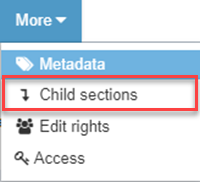
T4 v8.4.2 - Child sections is a new tab on the 'content in this section' view:

Advanced users only - A new option 'Accessibility Report' is visible from the Actions button. This tool's recommendations are usually outside the range of capabilities for standard website editors but they can be useful to CMS administrators with responsibility for the University's overall web presence.
T4 On-Demand Course
The eagerly-awaited on-demand training course for T4 v8 launched on the 29th of October.
This on-demand training is now mandatory and we recommend you take this training as soon as possible. The course must be completed on the one device using the one browser to ensure you receive your Digital Badge on completion. Ensure you follow all the Course Instructions on the Course webpage before you begin the course.
The full course (with tasks) is approx. 6hrs long, we know it can be difficult to find the time to do a day's training so we've designed a course that adapts to your work day. It is made up of a number of short videos and tasks, which can be taken all at once or split into multiple sessions to suit everyone's schedule.
Content Types
The last quarter of the year saw some improvements to our content types:
In early October, a new Table of Contents (ToC) content type was introduced, which allows you to easily added page-level navigation to individual webpages. Great for longer articles, it is automatically built from the headings in the page, and serves 2 functions: (1) Allow ingthe visitor to quickly jump to various parts of the webpage, and (2) displaying the visitor's location as they scroll through the content. More information on the ToC content type
In November, improvements were made to some existing content types:
Sidebar content boxes were given 5 more colour options: Black, aqua-marine, purple, dark maroon, and lime.
Content boxes' width can be set to auto, to take up all available space. They also have a new option to have a block background colour for the full box - not just the title.
Countdown underwent accessibility improvements and now also has multiple colour options.
Website Gap Analysis Project
A web gap analysis project has begun and will run over the next 4-6 months. It aims to fully understand our University's web-related goals, identify anywhere our website / CMS configuration can be improved, and develop a roadmap to address any identified shortcomings.
[Sep 1]
Search
Issue resolved
The website search had stopped working in the Irish site (ong.ie) - it's unknown when it broke for Irish pages but it was detected by ISS and immediately resolved in May.
New search solution Required
Microsoft notified us in May that they will discontinue Bing custom search on Aug 11, 2025. We have used this to power our website searches for the past 8 years. Before that, we used google search appliances that were hosted on-campus (until our site outgrew them).
The Web Governance Group is looking into possible replacement search services.
Given the very tight deadline, it is fully expected that the Bing will be turned off, by Microsoft, before we can procure, configure, test, and roll-out an enterprise search solution, which is why the following mitigation efforts are planned:
- The introduction of a Course Search feature to the Main course page.
This was built by the ISS Web Team, by extending the existing behaviour of our various course pages. Instead of creating a search solution with a single results page, each of the course pages can behave like a results page and the search panel knows which of these to point the user to.
(Implemented: June 19) - (Possibly) Place the same Course Search on the University Home Page
- (Ideally) A similar ability to search for courses via the Mega Menu, on each page of the website.
- Modify the existing site search results page to redirect site visitors to an external search engine (e.g. Google.ie). Even though this is undesirable (because competitors' paid ads may appear above our own search results), it is preferable to having no site search feature available - and the difficulties this would cause for site visitors.
Course Pages
An inter-disciplinary project group, involving personnel from ISS (Web team), Student Recruitment, Global Galway, Fees, Marketing & Communications, and a team from global digital transformation experts 'Granite', undertook a project to transform and improve our University course web pages. The project aimed to make all University course pages more mobile-friendly, intuitive, useful, informative, and easier to manage (particularly for recurring annual updates, such as: fees, CAO points, and start dates). This project was prompted by the introduction of new standards for QQI compliance - an important target for attracting international students.
The Design phase lasted between February and April, and rollout, by a dedicated team from Student Recruitment is ongoing. Most undergraduate courses and roughly 33% of our postgraduate courses were converted to the new format by September. Knock-on effects, from this work, affecting other aspects of the University website (such as the wider courses area and college/school/discipline sites) were addressed by the ISS web team.
Cookie Banner modifications
By law, the cookie banner must pop up on any webpage if you have not visited the site before, or if it has been 6 months since you last selected your cookie preferences.
To facilitate efforts to gain a more complete understanding of user behaviour on our website, 3 changes have been made to the cookie banner's behaviour, maximising its efficacy. It now:
- Appears immediately (if it needs to be shown)
- Pushes the site content down, when it appears, to make room for the banner
- Stays on the screen, overlaying the rest of the site content, if you scroll through the page.
The reasoning behind these 3 changes are fully explained below:
1. As a part of efforts to maximise our understanding of visitor behaviour (to gauge the effectiveness of our website and any marketing campaigns), the cookie banner has been configured to appear immediately when the page loads. Previously, it waited 15 seconds, before appearing, but this delay could conceivably allow visitors to navigate away from a page before their page visit was logged, thereby giving the University an inaccurate picture of the paths that some people take through our website.
2. The cookie banner previously overlaid the site content until you made your cookie consent choice. This was to ensure it was visible on the screen, regardless of how far down you had scrolled, in the 15 seconds since the page had loaded. However, temporarily covering existing page content made some accessibility scanners (which regularly monitor us for compliance with our legal accessibility obligations) wrongly think that there were accessibility issues on every scanned page. To combat this, the cookie banner now pushes the site content down, when it loads, ensuring the banner has nothing behind it.
3. It was possible for mobile users to scroll past the cookie banner, enabling some people to avoid making a choice altogether. The University can understand how people use its website (in a general sense) if they consent to cookies - and it's also possible to understand user behaviour (to a lesser extent) if they reject cookies - but you must know whether the site visitor accepts or rejects cookies before you can employ the correct method. So, the cookie banner now stays on the screen, no matter how much you scroll (even on mobile devices), making it far less likely to be ignored by any site visitors.
Affiliate Site Colour-Scheme Issues (Remediation Work in Progress)
Affiliate websites are those that are hosted by this University but not wholly run by the university - typically, multi-institutional research groups would fall into this category. These websites are allowed to use their own colour scheme and publish their own logo, alongside the University's one - while at the same time, taking advantage of the University CMS, and all its content types, for quick and easy website development.
We noticed, very early in the year, that a delayed reaction had begun affecting affiliate websites, where the University brand colours were now overriding certain aspects of their colour schemes, and hiding their logo. The colour changes were introducing accessibility issues, in some cases, where the the correct text colour was now appearing on an incorrect background colour. The resulting inadequate contrast adversely affected the legibility of the website text.
The mechanism that powers affiliate sites was upgraded to counteract the problems caused by the way the University's designers chose to apply our brand colours; however, a website conversion process is necessary to apply this change. This has been automated inasmuch as possible. We worked our way through each affiliate site, converting them to the latest affiliate template, to restore their correct look and feel.
The issue has been resolved for all websites that use the affiliate template: Acadamh, Abbey Theatre Minute Books, BioInnovate, Blood Cancers, CFRC, CDLP, CEGS, CHARMS, Corrib Core Lab, ILAS, Moore Institute (Draft), ROCSAFE, Stem Cells, and Shannon College.
Twitter Icon
The Twitter icon, that appears in the footer of most websites, has been replaced with an X icon to reflect the renaming of that social media platform.
[Feb 16]
Course Module Information Glitches
In January, course modules were affected by 2 distinct issues.
First, Google Analytics (GA), required by M&C, suddenly began breaking the module information pages for some users - and this only happened to those users who had given it permission to work without needing to modify the website content. We were unable to discover who was responsible for this obvious mis-configuration of the analytics tool, which is not managed or supported by ISS, so we took the only remaining option available to us - we modified our module viewer to make it GA-proof.
[This issue was resolved by Jan 14]
Second, courses with subjects defined (e.g. Arts) had become very difficult to understand for web visitors because the auto-inserted headlines, outlining the subject name and prerequisites for that subject had stopped displaying. This meant that a confusing list of optional and required modules (which added up to far more than 60 credits) was displayed for each year.
This issue greatly reduced the usefulness of the course module lists for some of our most popular courses - a feature that is very useful to prospective and current students, alike (See an example - this list appears in the 'BA Arts' course page). Unfortunately, this usability issue had begun happening at least a year before it was reported but it was only brought to our attention in the first week of February.
[The issue was resolved fully by February 14]